Current local store
The Android device is the operational source for the current Solo workflow.
Architecture direction
Fenwix currently stores core Solo inspection content in an encrypted app-private Android database and evidence vault rather than a Fenwix-hosted inspection database. Stable identities and a versioned canonical bundle are implemented foundations. The target shared architecture goes further with customer-controlled storage, provider-neutral connectors, resumable transfer, conflict handling and recovery before production synchronization is claimed.
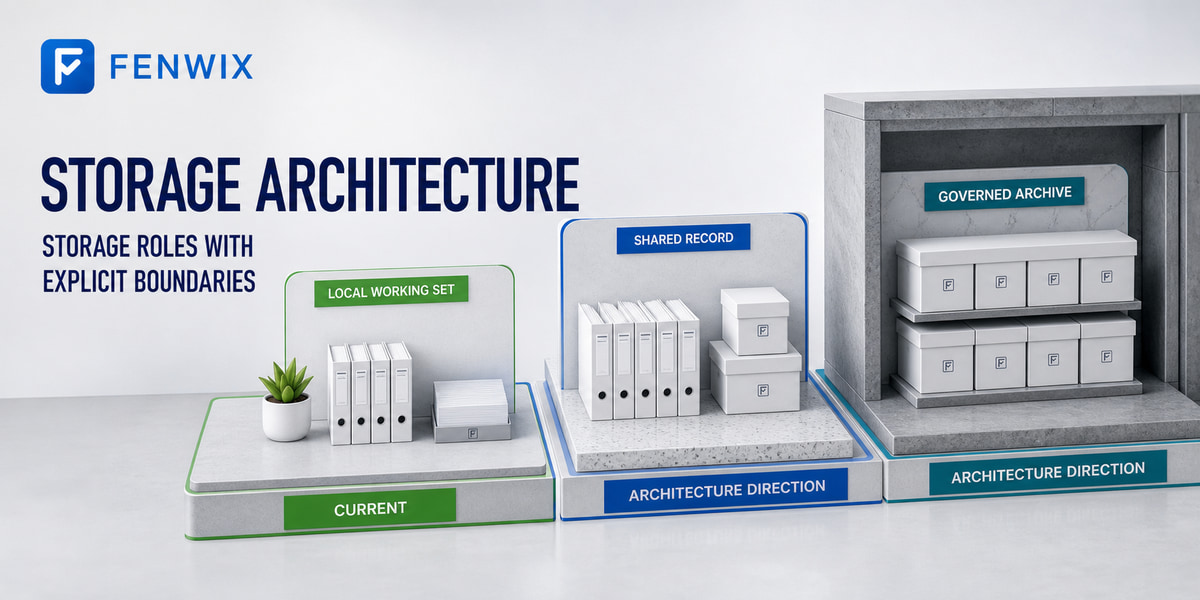
Local Solo storage is current. Customer-controlled shared repositories, remote end-to-end encryption and provider connectors are planned architecture and must not be read as available product features.
The Android device is the operational source for the current Solo workflow.
The customer chooses and controls the repository used by authorized devices.
Record identity and integrity must survive a storage-provider change.
CURRENT FOUNDATION
ENCRYPTED APP-PRIVATE RECORD
        ↓
VERSIONED CANONICAL BUNDLE

TARGET SHARED LAYER
PROVIDER ADAPTER + QUEUE
        ↓
CUSTOMER-CONTROLLED STORAGEFenwix Solo writes operational inspection content to an encrypted app-private database and evidence vault on the Android device. Core work does not depend on a hosted account or inspection-content database. Users can produce reports and use explicit Save, Share, Full Export and backup paths.
A backup is a recovery artifact taken at a point in time. Synchronization coordinates ongoing records across devices, handles identity and conflict, resumes interrupted transfer and preserves causality. Calling a copy operation sync would hide these obligations.
The roadmap requires more than a provider API. Stable identity, data classification, encrypted local surfaces and a versioned canonical bundle are implemented foundations. Fenwix must still complete provider-neutral transfer, entitlement rules, conflict and recovery behavior, then validate the first real provider against the same contract.
Provider-specific file IDs, paths, cursors and transfer metadata belong to the transport layer, not the canonical inspection identity. If the design holds, changing storage provider does not change what the record is or how its integrity is interpreted.
Core inspection content is stored in an encrypted app-private local database and evidence vault on the Android device.
Yes. Current Fenwix Solo encrypts its app-private database and evidence-vault objects at rest with device-local protected keys. This is not remote E2EE or cloud synchronization.
No. Shared customer-controlled storage and its connector layer are planned.
No. The PDF is a derived artifact; the structured source record and evidence context are the verification basis.
The target architecture keeps canonical identity independent of provider file IDs and paths.
Use Fenwix Solo's local behavior as the current baseline. Treat shared customer storage as available only after its encryption, identity, conflict and recovery gates are implemented and verified.
Content status: ARCHITECTURE_DIRECTION · Last reviewed: 2026-08-16
Claim basis: Fenwix Zero-Custody master plan · Fenwix product decision record · Fenwix.net aligned master brief