Location
The organization should be able to identify the device, storage provider and jurisdiction in which each data class resides.
Data architecture
Data sovereignty in field operations means knowing where inspection records live, which legal and organizational controls apply, who can access them and whether the customer can move or retain them independently. Fenwix Solo currently keeps core inspection content on the Android device; customer-owned shared storage remains an architecture direction.
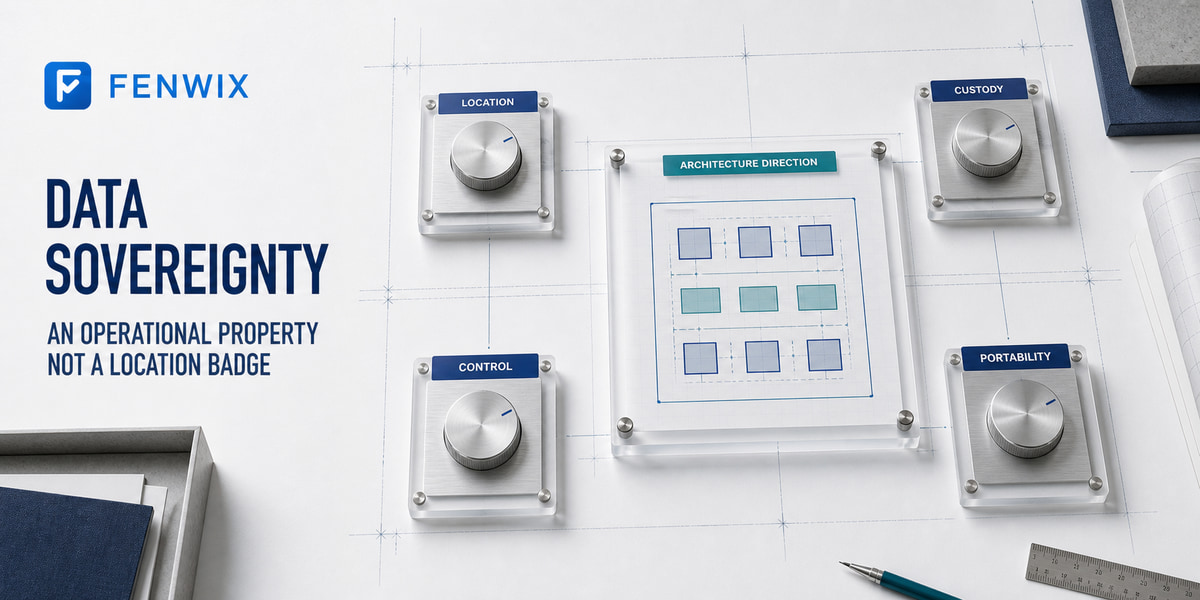
Current Solo provides a local, vendor-database-independent foundation. Shared customer-owned storage, connectors and enterprise policy controls are not available today.
The organization should be able to identify the device, storage provider and jurisdiction in which each data class resides.
Operational inspection content should not need to pass through a vendor repository by default in the target architecture.
Access, retention, export and recovery decisions must remain understandable and testable rather than implied by a cloud label.
FIELD RECORD
      ↓
KNOWN STORAGE LOCATION
      ↓
DEFINED ACCESS + RETENTION
      ↓
PORTABLE CUSTOMER-CONTROLLED RECORDThe physical or contractual location of a file is only one part of sovereignty. A useful assessment also covers controller and processor roles, administrative access, encryption keys, support access, retention, backup, deletion, portability and failure recovery.
The current Solo workflow stores core inspection content in an encrypted app-private local database and evidence vault. It does not require a Fenwix account or a Fenwix-hosted inspection-content database. Content leaves private storage only through user-directed functions such as Save, Share, Full Export, backup or support submission.
The target Customer-Owned Data Plane keeps shared operational records in storage controlled by the customer and uses a provider-neutral Field Data Protocol. Fenwix services should coordinate licensing and product operations without becoming the default repository for field content.
A product can advertise regional hosting while retaining broad support access, proprietary export or vendor-managed keys. Procurement should test operational boundaries rather than accept a location badge as the complete answer.
No. It reduces vendor custody for current Solo content, but device security, backup, access, retention, legal scope and recovery still need controls.
The current Solo architecture does not require a Fenwix-hosted inspection-content database for core operation.
No. Customer-owned shared storage and connectors are architecture direction, not a current product capability.
No. Residency concerns where data is located; sovereignty also includes applicable authority, custody, access, portability and operational control.
No. Compliance depends on the full technical, contractual, organizational and legal implementation for the deployment.
Separate what Fenwix Solo does now from the customer-owned shared architecture, then verify storage, access, export and recovery for the deployment you are considering.
Content status: ARCHITECTURE_DIRECTION · Last reviewed: 2026-08-16
Claim basis: Fenwix Zero-Custody master plan · Fenwix product decision record · Fenwix.net aligned master brief