Current foundation
Offline field record, local evidence, report identity and scoped verification.
Enterprise direction
Fenwix enterprise architecture is a staged direction, not a currently available enterprise suite. Today's Solo product provides offline local records, evidence context, revisions and reports. The next layer targets a customer-owned data plane; organization policy, RBAC, SSO, relay services and regulated deployment controls come later.
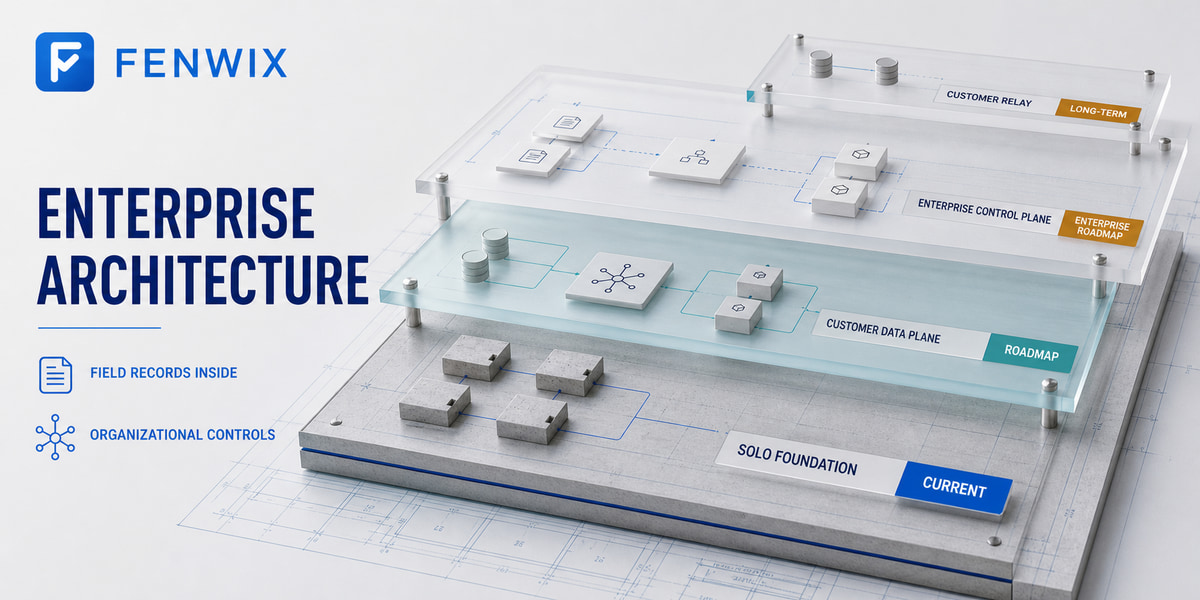
This page describes a layered target architecture. Only capabilities marked current are available in the Solo product; no enterprise plan, workspace or integration is being offered as production-ready here.
Offline field record, local evidence, report identity and scoped verification.
Customer-controlled synchronization through provider adapters, a durable queue, explicit conflict handling and tested recovery.
Organization policy, role authorization, identity federation, relay and governance.
CURRENT SOLO FOUNDATION
          ↓
CUSTOMER-OWNED DATA PLANE
          ↓
ORGANIZATION POLICY + RBAC
          ↓ optional
CUSTOMER RELAY + ENTERPRISE SYSTEMSThe current product is an Android, local-first inspection workflow. It creates structured inspection records, keeps evidence context, follows findings and corrective action, generates PDF reports and performs supported verification from the local source record.
The next architecture layer must build on the current identity, local encryption and canonical bundle foundation to synchronize authorized devices without making Fenwix the default owner of shared inspection content. It still requires provider-neutral connectors, a durable transfer queue, explicit conflict handling and tested recovery.
Team operation introduces authorization and policy questions that storage access controls alone cannot answer. Organization identity, role boundaries, approval, template governance, retention, trusted time and audit export require a distinct control model.
An optional Customer Relay can provide policy distribution, credential brokering, event integration and controlled connection to customer systems while operational content remains in the customer's data plane. It is not a backdoor vendor repository.
Evaluate the current Solo product only for current needs, and treat each later layer as a gated architecture proposal. A future-state diagram should never substitute for an implemented security review, data-flow test, recovery exercise or contract.
No. The current product is Solo and local-first; shared enterprise workspace capabilities are roadmap scope.
No. They belong to the enterprise governance direction and are not current product claims.
The target Zero-Custody direction places operational content in customer-controlled storage rather than a default Fenwix repository.
The planned relay is optional and intended for deployments that need customer-network policy or integration services.
No production-ready enterprise pilot is claimed. Required identity, encryption, protocol, connector and recovery gates must be implemented first.
Use the current Solo workflow for what it demonstrably does. Require implementation evidence, security review and recovery tests before treating any enterprise architecture layer as deployable.
Content status: ARCHITECTURE_DIRECTION · Last reviewed: 2026-08-16
Claim basis: Fenwix Zero-Custody master plan · Fenwix product decision record · Fenwix.net aligned master brief